Table Of Content
Studies using a wait-list partial randomization design are also included in Table 2 (24, 27, 42). These types of studies are well-suited to settings where there is routine enumeration of a cohort based on a specific eligibility criteria, such as enrolment in a health plan or employment group, or from a disease-based registry, such as for diabetes (27, 42). It has also been reported that this design can increase efficiency and statistical power in contrast to cluster-based trials, a crucial consideration when the number of participating individuals or groups is small (22).
Access options
School-based health care: improving academic outcomes for inner-city children—a prospective cohort quasi ... - Nature.com
School-based health care: improving academic outcomes for inner-city children—a prospective cohort quasi ....
Posted: Wed, 08 Feb 2023 08:00:00 GMT [source]
This increases the chances that secular trends, policy changes, or other external forces impact study results. This may occur deliberately in some cases—for example, if sites that develop their implementation plans first are assigned to earlier waves. Even if sites are randomized, however, early and late wave sites may still differ on important characteristics such as size, rurality, and case mix.

What Are the Threats to Establishing Causality When Using Quasi-experimental Designs in Medical Informatics?
Can a quasi-experimental research employ multimethod approach? - ResearchGate
Can a quasi-experimental research employ multimethod approach?.
Posted: Mon, 10 Feb 2020 08:00:00 GMT [source]
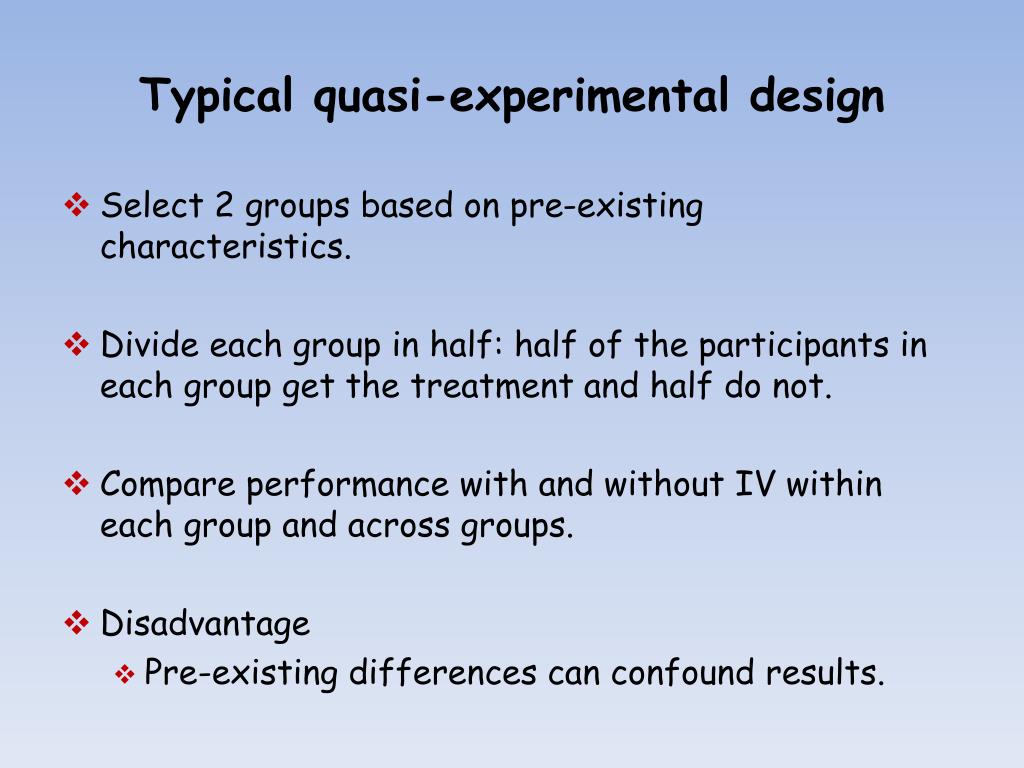
This design involves studying the effects of an intervention or event that occurs naturally, without the researcher’s intervention. For example, a researcher might study the effects of a new law or policy that affects certain groups of people. Quasi-experimental design is a research method that seeks to evaluate the causal relationships between variables, but without the full control over the independent variable(s) that is available in a true experimental design.
Collect data over time
“Resemblance” is the definition of “quasi.” Individuals are not randomly allocated to conditions or orders of conditions, even though the regression analysis is changed. As a result, quasi-experimental research is research that appears to be experimental but is not. In a classic 1952 article, researcher Hans Eysenck pointed out the shortcomings of the simple pretest-posttest design for evaluating the effectiveness of psychotherapy. The study by Grant et al et al uses a variant of the SWD for which individuals within a setting are enumerated and then randomized to get the intervention.
2. Interrupted Time Series
Something could occur at one of the schools but not the other (e.g., a student drug overdose), so students at the first school would be affected by it while students at the other school would not. In a pretest-posttest design, the dependent variable is measured once before the treatment is implemented and once after it is implemented. Imagine, for example, a researcher who is interested in the effectiveness of an antidrug education program on elementary school students’ attitudes toward illegal drugs. The researcher could measure the attitudes of students at a particular elementary school during one week, implement the antidrug program during the next week, and finally, measure their attitudes again the following week.
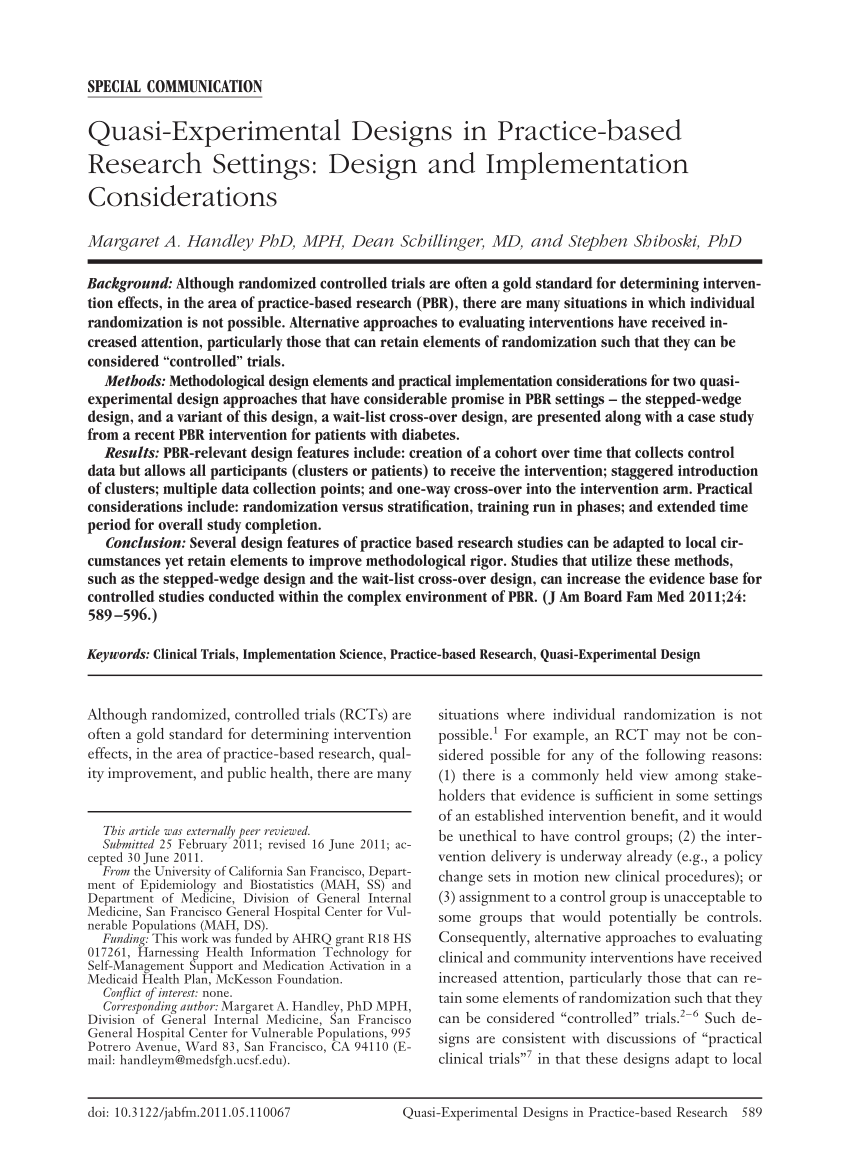
A quasi-experimental design is used when it's not logistically feasible or ethical to conduct randomized, controlled trials. The Behavioral Health Interdisciplinary Program (BHIP) Enhancement Project is a recent example of a stepped-wedge implementation trial (Bauer et al., 2016; Bauer et al., 2019). Figure 2 illustrates the implementation and stepdown periods for that trial, with black dots representing primary data collection points. In order to enhance the causal inference for pre-post designs with non-equivalent control groups, the best strategies improve the comparability of the control group with regards to potential covariates related to the outcome of interest but are not under investigation. One strategy involves creating a cohort, and then using targeted sampling to inform matching of individuals within the cohort.
Discontinuity in regression
For instance, providing public healthcare to one group and withholding it to another in research is unethical. A quasi-experimental design would examine the relationship between these two groups to avoid physical danger. Instead of allocating these patients at random, you uncover pre-existing psychotherapist groups in the hospitals. Clearly, there’ll be counselors who are eager to undertake these trials as well as others who prefer to stick to the old ways. This means that each person has an equivalent chance of being assigned to the experimental group or the control group, depending on whether they are manipulated or not.
An example comparing a true experiment and quasi-experiment
The pre-post with non-equivalent control group uses a control group in the absence of randomization. Ideally, the control group is chosen to be as similar to the intervention group as possible (e.g. by matching on factors such as clinic type, patient population, geographic region, etc.). Theoretically, both groups are exposed to the same trends in the environment, making it plausible to decipher if the intervention had an effect.
Quasi-experimental Designs That Use Control Groups and Pretests
Students in a similar school are given the pretest, not exposed to an antidrug program, and finally are given a posttest. Again, if students in the treatment condition become more negative toward drugs, this change in attitude could be an effect of the treatment, but it could also be a matter of history or maturation. If it really is an effect of the treatment, then students in the treatment condition should become more negative than students in the control condition. But if it is a matter of history (e.g., news of a celebrity drug overdose) or maturation (e.g., improved reasoning), then students in the two conditions would be likely to show similar amounts of change. This type of design does not completely eliminate the possibility of confounding variables, however.
The design involved matching clinics by size and an inverse roll-out, to balance out the sizes across the four groups. The inverse roll-out involved four strata of clinics, grouped by size with two clinics in each strata. The roll-out was sequenced across these eight clinics, such that one smaller clinics began earlier, with three clinics of increasing size getting the intervention afterwards.
Nonetheless, there are design strategies for non-experimental studies that can be undertaken to improve the internal validity while not eliminating considerations of external validity. There is a relative hierarchy within these categories of study designs, with category D studies being sounder than categories C, B, or A in terms of establishing causality. Thus, if feasible from a design and implementation point of view, investigators should aim to design studies that fall in to the higher rated categories.
Variables a and b should assess similar constructs; that is, the two measures should be affected by similar factors and confounding variables except for the effect of the intervention. Taking our example, variable a could be pharmacy costs and variable b could be the length of stay of patients. If our informatics intervention is aimed at decreasing pharmacy costs, we would expect to observe a decrease in pharmacy costs but not in the average length of stay of patients. However, a number of important confounding variables, such as severity of illness and knowledge of software users, might affect both outcome measures.




No comments:
Post a Comment